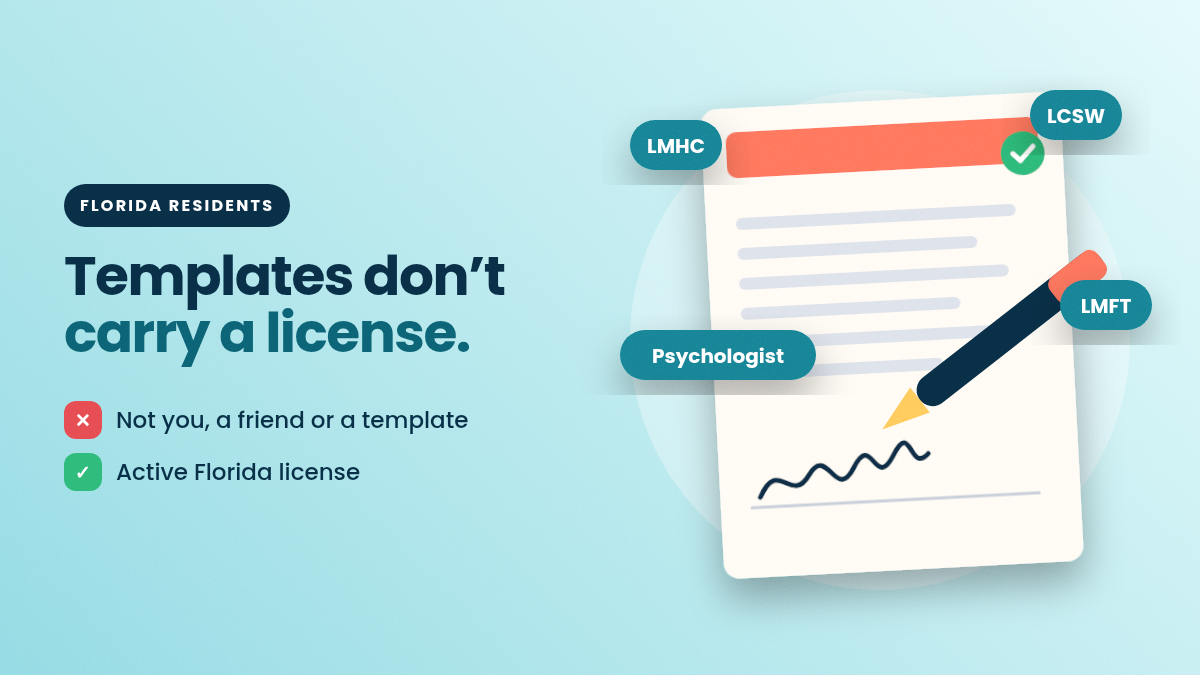
Licensed professionals who can issue an ESA letter in Florida are clinicians with an active license to assess mental and emotional health, such as licensed mental health counselors, clinical social workers, marriage and family therapists, psychologists and psychiatrists. The letter only carries weight when that professional has personally evaluated you and judged that an emotional support animal helps with a condition that limits daily life. A friend, a breeder or the tenant cannot write it.
Florida renters usually meet this question when a landlord asks for documentation before approving an animal in a no pets building. Working with a licensed Florida therapist for an ESA letter means the clinician's license can be checked against state records, which is often the first thing a property manager does. The sections below explain who can sign, what the letter must show and where the process tends to go wrong.
Can I make my own ESA letter?
No, a letter you write for yourself has no standing because it does not come from a licensed professional who evaluated you.
An ESA letter is a form of disability verification. Its value comes from three things: the clinician's license, the evaluation behind it and the professional's willingness to be contacted. A self written note, a filled in template or a letter signed by a relative skips all three, so a landlord can treat the request as unsupported and ask for proper documentation.
Sample letters online can show you what the format looks like, but completing one yourself does not make it valid. Florida law also treats knowingly misrepresenting a need for an emotional support animal as an offense, so a homemade letter can create legal trouble for a renter instead of solving a housing problem.
Who can write an ESA letter in Florida?
Any clinician licensed to diagnose or treat mental and emotional conditions can write one, provided they have evaluated you.
The Florida Department of Health licenses these professionals through dedicated boards, and every active license has a number that anyone can look up online. Each type below can support an ESA letter when the holder has evaluated you, and these are the titles that appear most often on Florida letters:
- Licensed Mental Health Counselor (LMHC), the Florida title for what many other states call an LPC
- Licensed Clinical Social Worker (LCSW)
- Licensed Marriage and Family Therapist (LMFT)
- Licensed psychologist holding a PhD or PsyD
- Psychiatrist holding an MD or DO
- Advanced Practice Registered Nurse with a psychiatric or mental health focus
Interns still working toward one of these licenses generally cannot sign alone, because the letter needs a fully licensed provider whose number a landlord can confirm. The title matters less than the relationship. The professional should have assessed your symptoms directly and be able to explain, if contacted, why the animal helps you manage daily life.
Can a family doctor or nurse practitioner sign a Florida ESA letter?
Yes, a physician or nurse practitioner who understands your mental health history can sign one, although many prefer to refer you.
Medical doctors and nurse practitioners hold licenses that cover diagnosis and treatment, so their letter is valid when they have evaluated the emotional condition behind the request. In practice, some primary care providers feel they lack the mental health background to comment on an assistance animal and will point patients toward a counselor or psychologist instead.
That referral step is where many renters lose weeks. A common alternative is an ESA letter from a licensed therapist whose work centers on emotional and psychological assessment, because the evaluation then covers the same questions a landlord's verification may raise. Either route is sound when the provider is licensed and the assessment is genuine.
Why does a registry certificate not count as an ESA letter in Florida?
A registry certificate is not an ESA letter, because no licensed professional evaluated you and no state runs an ESA registry.
Some websites sell certificates, ID cards or a listing in a database. Florida does not operate an ESA registry, and neither does any other state. A landlord reviewing an accommodation request is looking for a clinician's letter, not a registration number, so these products do not meet the documentation standard on their own.
Florida's fair housing law addresses this directly by stating that information from websites selling certificates or registrations is not, by itself, enough to show a disability related need. Renters who bought one of these products can still request a proper evaluation and replace the certificate with a letter from a licensed provider.
What does a Florida landlord check on a therapist's ESA letter?
A landlord checks that the letter is complete and that the clinician's license is real, but cannot ask about your diagnosis.
Missing details are the most common reason a landlord asks for more paperwork, so it helps to know what a complete letter contains before you submit it. A letter that holds up under review usually includes these details:
- The clinician's letterhead, name and contact details
- License type, license number and state of licensure
- Issue date and the clinician's signature
- A statement that you have a condition that limits daily life and that the animal helps
Property managers may look up the license number through the Florida Department of Health and may contact the provider to confirm the letter is genuine. They cannot request medical records, the name of your condition or details of your treatment, and the diagnosis itself does not need to appear anywhere on the letter.
These rules apply to housing covered by the Fair Housing Act and Florida's own fair housing law. After HUD's May 22, 2026 enforcement memo rescinded its earlier assistance animal guidance, state enforcement now takes the primary role and HUD a secondary one. The current position on documentation, fees and denials is summarized under Florida ESA laws.
How does an online evaluation with a Florida licensed professional work?
An online evaluation works like an office visit when a clinician licensed in Florida conducts it live and decides based on your answers.
Telehealth is accepted for this kind of assessment as long as a real clinician leads it. The professional asks about your symptoms, how they affect sleep, work, study or relationships, and how the animal helps. If the need is clinically supported, they issue a signed letter. If it is not, no letter is written, and that outcome is part of what gives the process its credibility.
RealESALetter.com connects Florida residents with clinicians licensed in the state, and a letter is issued only when clinically appropriate. Each letter is signed on letterhead with the clinician's license number, issue date and contact details, and landlord support is available if a letter is questioned. The national rules on who can write an ESA letter follow the same principle, with each state setting its own license titles.
Frequently Asked Questions
Can an LMHP sign an ESA letter in Florida?
Yes. A licensed mental health professional, such as an LMHC, LCSW, LMFT or psychologist, can sign an ESA letter after evaluating you. The license must be active, and the number should appear on the letter so a landlord can verify it.
What are the ESA letter requirements in Florida?
The letter should come from a licensed clinician who evaluated you and should list their license type, number, state of licensure, issue date, contact details and signature. It must state that you have a condition that limits daily life and that the animal helps. It does not need to name your diagnosis.
Can my current therapist write my ESA letter?
Yes, if your therapist is fully licensed and believes an emotional support animal helps with your condition. Some therapists decline for professional or employer policy reasons. In that case, a separate evaluation with another licensed clinician is a normal next step.
Does the clinician need a Florida license?
A clinician licensed in Florida is the simplest choice, because the landlord can confirm the license through the Florida Department of Health without much effort. A letter tied to the state where you live also avoids questions about whether the provider can evaluate Florida residents.
Can a landlord reject a letter from a licensed professional?
A landlord can question a letter that is incomplete or cannot be verified. Within covered housing, lawful grounds for denying the animal are limited to a direct threat from the specific animal, serious property damage or an undue burden. A complete letter from a licensed clinician addresses the documentation side of the request.
A valid Florida ESA letter comes only from a licensed professional, such as an LMHC, LCSW, LMFT, psychologist, psychiatrist or qualified physician, who has evaluated the tenant personally. Self written letters and registry certificates do not meet that standard. RealESALetter.com gives Florida residents a live evaluation with a clinician licensed in the state and a signed letter that landlords can verify.
